
Behind Sunbelt Rentals at the NYSE
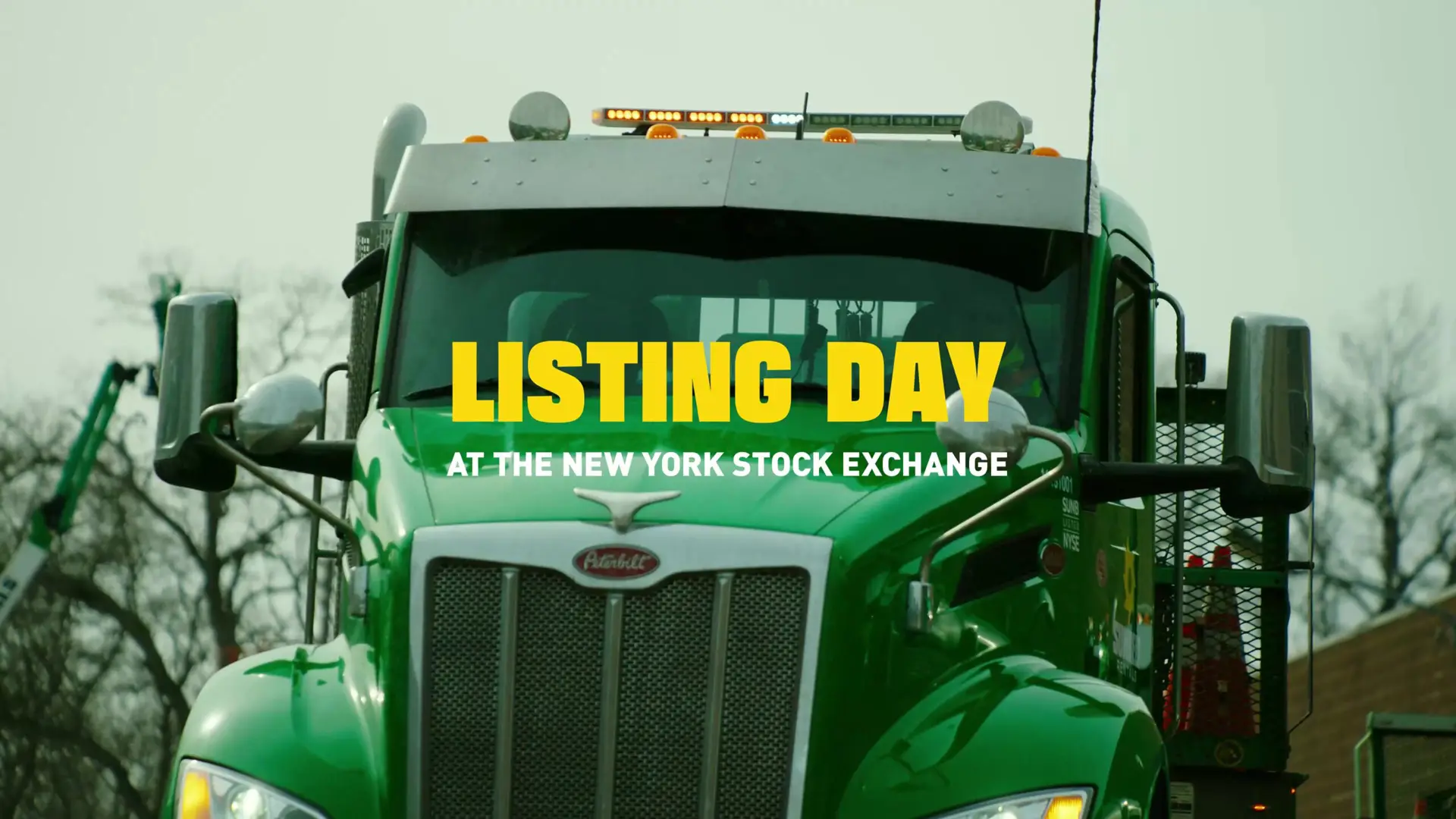
Every so often a job comes across the desk that carries a particular kind of pressure. Not the pressure of a big budget or a demanding client, but the pressure of a moment in a company’s history that will not repeat. Sunbelt Rentals re-listing on the New York Stock Exchange was that kind of job. A single day. Two entirely different worlds inside one city. One finished film, delivered before the day was over. This is a producer’s account of how the work actually happened, from the first brief through the moment we handed over the cut.
Interpreting the Brief
When Sunbelt Rentals came to us about documenting their re-listing on the New York Stock Exchange, the request on paper looked straightforward. They needed a film. They needed it fast. They needed the ceremony captured, and they wanted the identity of the company to come through in the coverage. The subtext, once we sat down with their team and walked through what the moment actually represented, was more layered than the ask suggested on the surface.
A re-listing is not a first listing. It is a return, and returns carry weight that first appearances do not. There is a sense of reclamation, a public acknowledgment that a business has arrived at a new chapter with a fuller version of itself. For Sunbelt, that chapter has been written over years of work on job sites the market rarely sees. Their brief did not spell that out. It did not have to. Our job, as we understood it, was to hear what the client was saying and also what they were not saying, and to hold both truths inside the same film.
We approached the initial conversations with a specific question in mind. What is this film for. Is it a keepsake for the executive team. Is it an internal piece for the wider organization. Is it external communication for the brand and the market. The honest answer, we discovered, was that it needed to work as all three at once. That framing shaped every decision downstream, from the size of the crew we deployed to the way we treated audio to how we thought about pacing in the edit. When a single deliverable needs to serve multiple audiences, the storytelling has to be simple enough to translate across all of them without losing its texture. Our role as a corporate video production partner is often exactly this kind of translation work.
The Creative Thesis
The idea that eventually anchored the entire film was one we arrived at during pre-production, and it stayed with us all the way through the final grade. The re-listing is not the story. The re-listing is the recognition of the story that was already being written out on job sites across the country. Everything we filmed, we filmed in service of that thesis.
What that meant in practice was that the Stock Exchange coverage, as important as the ceremonial moment was, could not be the entire film. If we treated Wall Street as the destination, we would be making a film about a financial event. If we treated Wall Street as the acknowledgment of ongoing work, we would be making a film about a company. Those are two different films. Sunbelt did not hire us to make the first one. The second one required that we go get the other half of the story before the day was over.
Once the thesis was clear, structural decisions began to make themselves. We would need active job site coverage on the same day as the bell. We would need the visual and auditory contrast between the two worlds to feel deliberate rather than accidental. We would need the interviews on the trading floor to speak in a register that could be intercut with equipment operators without one register mocking the other. And we would need to move fast enough on the day that the post team could still deliver by the close of business. The thesis, in other words, dictated the logistics.
Pre-Production for a NYSE Shoot
Filming inside the New York Stock Exchange is not the same as filming in any other location in New York. It is a working financial exchange with security protocols, credentialing timelines, restricted physical zones, wardrobe requirements, and a strict choreography around the bell itself. Getting a camera onto the floor requires coordination that starts weeks before the shoot. Our team spent significant time upstream of the shoot working through the exchange’s requirements and translating them into a plan our crew could actually execute against.
Credentials came first. Every person on the C&I team who would be inside the building needed to be listed, cleared, and confirmed well before the shoot day. Gear needed to be documented and pre-approved. We built a rig list that was intentionally conservative in size, because we knew that trying to move a large kit through the exchange’s security process would create friction we did not need. Small, capable packages. No extra bodies. Clear assignments for each operator.
Shot list constraints were the next conversation. The exchange has zones where cameras can and cannot go, angles that are permitted and angles that are not, and specific windows around the bell where certain coverage is possible and other coverage is not. We built our shot list against those constraints from the beginning rather than treating them as edits to work around. That inversion matters. When you plan around real constraints, the shot list you end up with is a list of shots you can actually get. When you plan around what you want and then edit for constraints, you spend the shoot cutting your own ambitions.
The construction site side of pre-production required a different kind of legwork. We needed active job sites in New York City that would be operating during the same window as the bell ceremony. We needed operators who were briefed enough to work naturally on camera without breaking the rhythm of their actual jobs. We needed safety coordination with site supervisors. And we needed the timing to line up so that our second unit could be filming while our first unit was still on the trading floor. Our experience running video production in New York made this easier than it would have been for a team new to the city, because location access and permit realities in New York are learned rather than looked up.
The Morning of the Bell
Call time on Wall Street was early. Earlier than most shoots. The exchange has a rhythm that begins long before the bell rings, and if you arrive to that rhythm rather than ahead of it, you have already lost the morning. Our crew was staged and inside the building with time to build rigs, set audio, and walk the floor for final blocking before the executive team arrived.
The bell moment itself is deceptively short. From the podium fill to the bell strike to the first minute of open trading, the entire ceremonial sequence takes only a handful of minutes. Everything that happens during those minutes is unrepeatable. There is no second take. There is no do-over on the executive who happened to raise their hand at the exact right beat. There is no second version of the crowd reaction on the floor below. The job of the crew during those minutes is to be in the right positions, with the right lenses, at the right heights, in the right numbers, so that every angle we planned for is being captured simultaneously.
To make that possible we ran multiple camera units in parallel. One unit was on the podium capturing the executives, the bell, and the tight coverage of the ceremony itself. Another unit was positioned on the floor to capture reactions, ticker context, and the wider environmental sense of the exchange in operation. A third unit was mobile, working the periphery for the moments that reveal themselves only if a camera is willing to move toward them. Audio was captured independently, with lav mics on the key principals and additional coverage for ambient. We did not rely on any single point of failure.
Interviews on the trading floor happened in the window immediately after the bell. There is a specific quality to those interviews that we tried to preserve in the edit. The people we spoke with had just come off the podium. They were still inside the moment. If you push interview coverage too late in the day, that immediacy is gone, and what you get instead is reflection. Reflection is useful, but immediacy is not something you can recreate. We shot the interviews close to the bell for that reason.
The Construction Sites
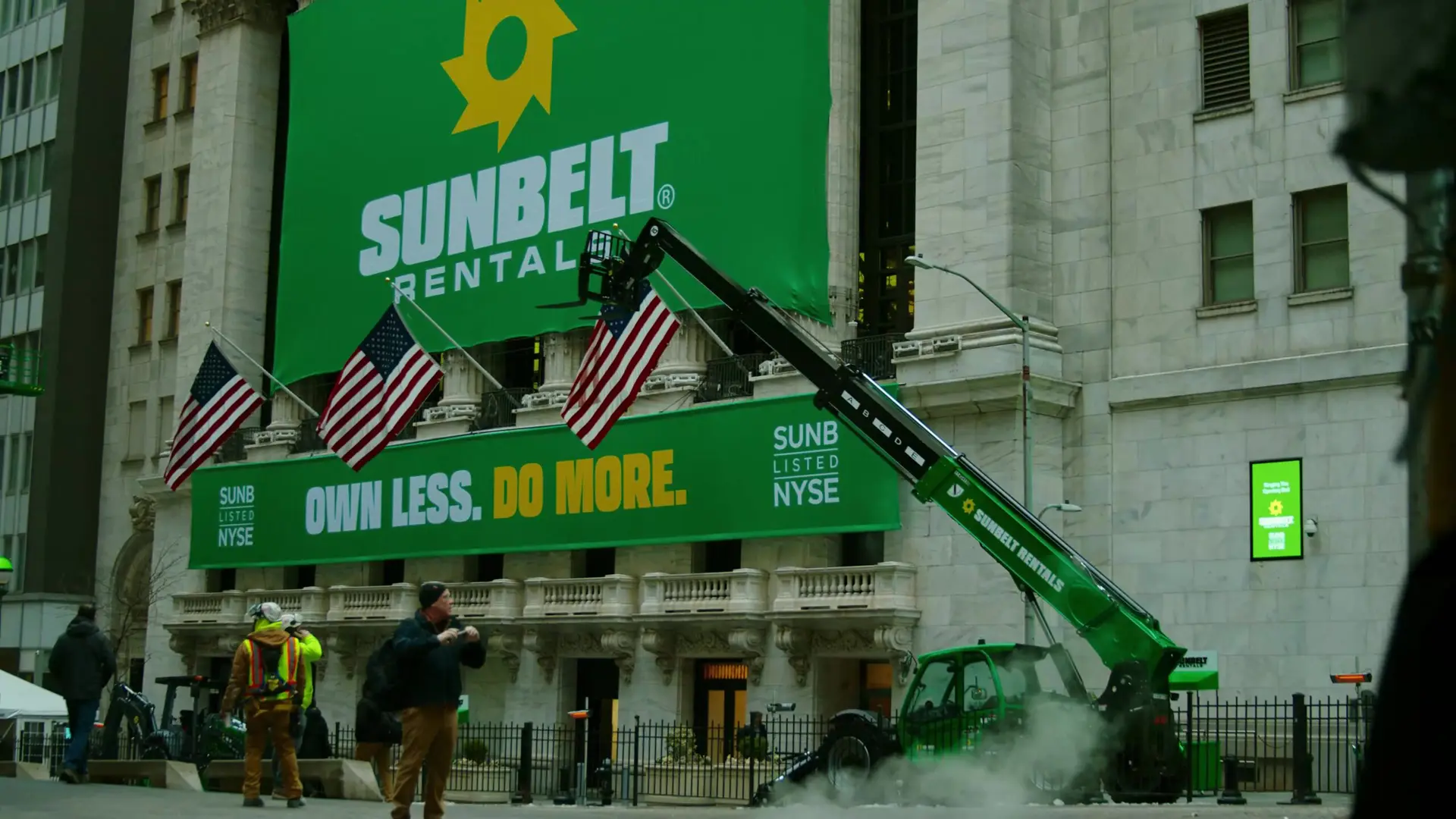
While the trading floor unit was working the bell, our second unit was already deployed across active Sunbelt Rentals job sites in New York City. Cranes were in operation. Aerial work platforms were in use. Ground equipment was moving. Operators were doing the actual work of their days. This coverage is the half of the film that most viewers would not expect from a NYSE re-listing story, and it is exactly the half that made the film mean something.
The visual language of a construction site is completely different from the visual language of a trading floor. Where the exchange is polished, gold-lit, formal, tightly framed, the job site is raw, weather-lit, loud, physical, wide, unpredictable. We did not try to soften either environment to make them meet in the middle. The contrast was the point. We shot the job sites with the same care and the same lens discipline as the trading floor, so that when the two worlds were cut together, they would feel like two chapters of the same book rather than footage borrowed from two different productions.
Editorially, the construction footage carries the argument of the film. Anyone can film a bell ringing. The bell is public. The bell is scheduled. The bell is the thing every news outlet in the city would capture in a wide two-shot and move on from. What no one else was going to capture on that day was the fact that while executives were on the podium in lower Manhattan, operators in other parts of the city were doing the work that made the podium possible. That parallel action is what turns a ceremony piece into a company piece. Delivering that kind of narrative reach across multiple locations is what we mean when we talk about full-scope video production services.
Cutting Between Two Worlds
Post began before the shoot ended. Our editorial lead had been ingesting footage from both units in the background all morning, and by the time the second unit began wrapping their last job site, an assembly was already coming together. Same-day delivery on a film with two locations, multiple camera units, and formal client stakes is only possible if post is running in parallel with production. Waiting until the shoot is over to start editing is a schedule you cannot recover from.
The cutting logic we settled on was rhythmic rather than chronological. We did not want the film to say, first we went to the exchange, then we went to the job sites. That would have flattened the thesis. Instead, the cut moves between the two worlds throughout, letting the bell and the beams echo each other, letting the podium and the platform sit inside the same breath. When we tightened the edit, the pattern that worked was one where a formal moment on the trading floor would land, and then the film would move to a physical moment on a job site that carried the same emotional weight in a completely different visual register.
Sound design was a separate conversation. Exchange audio has a very specific quality. The bell, the announcements, the ambient hum of the floor. Construction audio has an entirely different palette. Diesel, hydraulics, radios, wind. We treated the sound of both environments as characters rather than backgrounds, and let each environment’s sonic identity carry the emotional weight of its section of the cut. Interview audio sat above both, cleaned and prioritized, so that no matter which visual world the viewer was inside, the voices of the Sunbelt team remained the through-line.
Same-Day Post
Delivering a finished piece the same day as the shoot is a discipline as much as a technical achievement. It requires that pre-production has already made most of the editorial decisions before the first frame is captured. The shot list, the interview outline, the run of show, the target duration, and the intended cutting pattern were all agreed before we ever set up on the floor. On the day, we were executing a plan, not discovering one. That is what allowed the edit to move as quickly as it did.
Our post production team worked from a mobile setup that was already in position by mid-morning. As selects came in from both units, they were being logged, marked, and roughed in against the assembly. Interview transcription began during the shoot. Color and audio treatment happened on a compressed timeline that would have been unworkable without the preparation upstream. By late afternoon we were in final refinements. By evening we were delivering the film.
The reason to work this way is not the bragging rights of a same-day turnaround. The reason is that a moment like a NYSE re-listing has a window of relevance. The client wanted to share the film while the moment was still current, with their internal teams, their partners, and their audience. A finished piece the following week would have carried less weight. A finished piece the same day sat inside the moment it was documenting. That difference is worth the discipline it takes to deliver.
What a Job Like This Teaches You
Every project leaves a lesson if you slow down enough to name it. What this one reinforced for our team was that logistics and creativity are not separate departments. The reason the film could tell the story it did was that the logistical planning had already built the space for the story to exist. Two locations in the same day was not a scheduling choice. It was an editorial choice, executed as a schedule. The multi-unit approach was not a production luxury. It was the only way to capture what we needed inside a window that would not repeat.
The other lesson was about listening to what a brief is actually asking for. Sunbelt did not ask us for a film that reframed their listing as an acknowledgment of ongoing work. They asked us to document a ceremony. We arrived at the reframing by paying attention to what they cared about when they talked about their company. The most useful thing a production partner can do at the beginning of a job is to hear the full weight of what the client is trying to communicate, including the parts they are not putting into the brief document. That is where the difference between a competent film and a meaningful film usually lives.
Finally, there is the lesson of trust. A shoot like this only works because a client is willing to hand over an unrepeatable day to a team they believe will handle it. Sunbelt gave us access to the trading floor, to their executives, to their active job sites, and to their story, on a day they could not run twice. Being trusted with a moment like that is not something we take casually, and the film we delivered was our answer to that trust. The full portfolio piece is available here, and teams interested in working with us on projects of similar scale and stakes can reach the studio through our contact page.
Work with C&I Studios
If you are planning a project like this, our team can take it from concept to final delivery. Explore our video production services, browse our work to see how we tell brand stories, and get in touch when you are ready to start.