
How We Run a Multi City Video Production

A multi city video production looks simple on the brief and gets complicated the moment real calendars, real crews, and three different loading docks enter the picture. We run these campaigns often, and the thing that keeps them from falling apart is not luck. It is a way of working that treats five cities as one production with one spine, not five productions stitched together after the fact.
This is how we actually do it. Not the pitch version. The part where someone has to decide whether the Atlanta unit uses the same lens set as the New York unit, and who answers the phone when a permit slips.
First, the plain definition. A multi city video production is one campaign filmed in two or more cities, with a single creative, a single schedule and a single owner, so the footage from every market cuts together as if it came from one shoot. That last part is the hard part, and it is what the rest of this post is about.
One creative, held across every city
The brief comes first and it does not change city to city. Before anyone books a crew, we lock a single creative document that every unit works from. Shot framing, pacing, the look of the light, the way talent is directed, the tone of the interview questions. That document is the campaign. The cities are just where it gets captured.
When each location is allowed to interpret the brief locally, you end up with footage that is all technically good and completely unusable together, because one city shot everything warm and handheld and another shot cool and locked off. A real video production campaign across markets lives or dies on whether the creative was treated as fixed. We treat it as fixed.
From that one document we build per city shoot packages. Same scenes, same shot list, same framing notes, adjusted only for what the location physically requires. A warehouse interview in Dallas and a rooftop interview in San Francisco follow the identical setup rules even though the rooms could not be more different.
Local crews, run to one standard
We do not fly a single crew to every city and burn the budget on airfare and hotels. We staff local. The people who know the parking rules in Chicago or the freight elevator quirks in a Manhattan building are worth more than any traveling generalist, and they cost less to put to work.
The risk with local crews is drift. Five cities, five gaffers, five opinions about how bright the key should be. We close that gap with a crew brief that is not optional. Every unit gets the same call sheet format, the same lighting diagram, the same framing reference stills, and the same short list of what we will not accept. A lead from our side runs the standard across all of them so the Houston footage and the Atlanta footage feel like they came out of one room.
What it looked like on Celsius
The clearest example we can point to is our Celsius commercial. It was a 14 day shoot across six cities. Clemson, South Carolina. Columbus, Ohio. St. Louis, Missouri. Ann Arbor and Belleville, Michigan. And Los Angeles. The calendar was built around athletes, so their availability decided which city came when, and the locations had to work around them rather than the other way round.
We put together a complete production team in every one of those cities. Camera, lighting, sound and production assistants, all local, all working from the same detailed shot lists and scheduling documents written in pre production. Interiors like locker rooms and an auditorium got controlled lighting setups that could be rebuilt quickly as the unit moved between spaces. Exteriors like a football field and a stadium stand had to work with whatever natural light the day gave us. Different rooms, different crews, one commercial. We carried it through post production and the final edit ourselves, which is where the consistency either shows up or does not.

Gear continuity is a decision, not an accident
If the cameras and glass change city to city, the footage will not match, and no amount of color work fully saves it. So we make gear a continuity decision up front. We pick a camera body and a lens family, write it into the shoot package, and every local unit sources the same kit or the closest documented equivalent.
Sensor, codec, and frame rate are locked for the whole campaign. Lens set is locked. White balance targets and exposure practice are written down so a colorist is not reverse engineering five different crews in post. When a city genuinely cannot get a specific body, we approve the substitute ourselves and note exactly how it differs, so the edit knows what it is dealing with before anyone opens a timeline.
This is unglamorous and it is the difference between a clean assembly and a week of firefighting. The American Society of Cinematographers has written for years about matching across units, and the short version holds. Decide the look, then protect it with hardware choices, not hope. You can read the craft side of that thinking at the ASC.
Color matching that starts on set
People think color matching happens in post. The good version starts on set. Every unit shoots a reference chart and a gray card under their real lighting at the top of each setup. That gives our post production team a known anchor for each city instead of five mystery boxes.
In the grade we build one base look from the creative document, apply it as the starting point for all cities, then correct each unit toward that anchor rather than toward whatever looked nice in isolation. Skin tones get matched first because the eye forgives a lot but never forgives a face that shifts hue between cuts. By the time the campaign is assembled, a viewer cannot tell which shot came from which coast, and that is exactly the result the brand is paying for.
When a client needs the same story told through stills alongside motion, our photography teams shoot to the same reference discipline so the campaign reads as one visual system across formats.
Scheduling and travel without the chaos
Multi city scheduling is a logistics problem dressed up as a creative one. The trap is sequencing cities in a way that looks efficient on a map and is impossible on a calendar. We build the schedule backward from the delivery date and the one or two people who have to appear in more than one city, usually an executive or a brand lead whose travel drives everything else.
We stagger units so a small core team can move between markets if the creative needs a consistent director in the room, while the bulk of each crew stays local. Permits, location holds, and talent availability get confirmed in parallel, not one city at a time, so a slip in one market does not knock the next three off their dates. Weather and daylight go into the plan early, because a rooftop day in one city and a studio day in another are not interchangeable slots.
When a job calls for a controlled environment in at least one market, we route that unit through our Los Angeles studio, which gives us a fixed, weatherproof anchor day the rest of the schedule can lean on. Thirty thousand square feet means we can build a set once and know it is there.
| Campaign piece | Where it lives |
|---|---|
| Creative document | One version, every city builds from it |
| Crews | Local in each market, one standard |
| Camera and lens | Locked family, substitutes approved centrally |
| Color anchor | Set on day one, matched in the grade |
| Point of contact | One producer across all markets |
One producer, one phone number
The single most important decision in a multi city campaign is who the client calls. The answer is one person. One producer owns the whole thing, holds the creative, knows the status of every city, and is the only number the client needs. Everything else can be delegated. This cannot.
When problems are routed through five local coordinators, nobody sees the whole board and small issues become campaign issues. When they are routed through one producer who sees all five cities at once, a permit slip in Houston gets solved by shifting a day in Dallas before the client ever feels it. That is the quiet work a single point of contact makes possible, and it is why we never split that role.
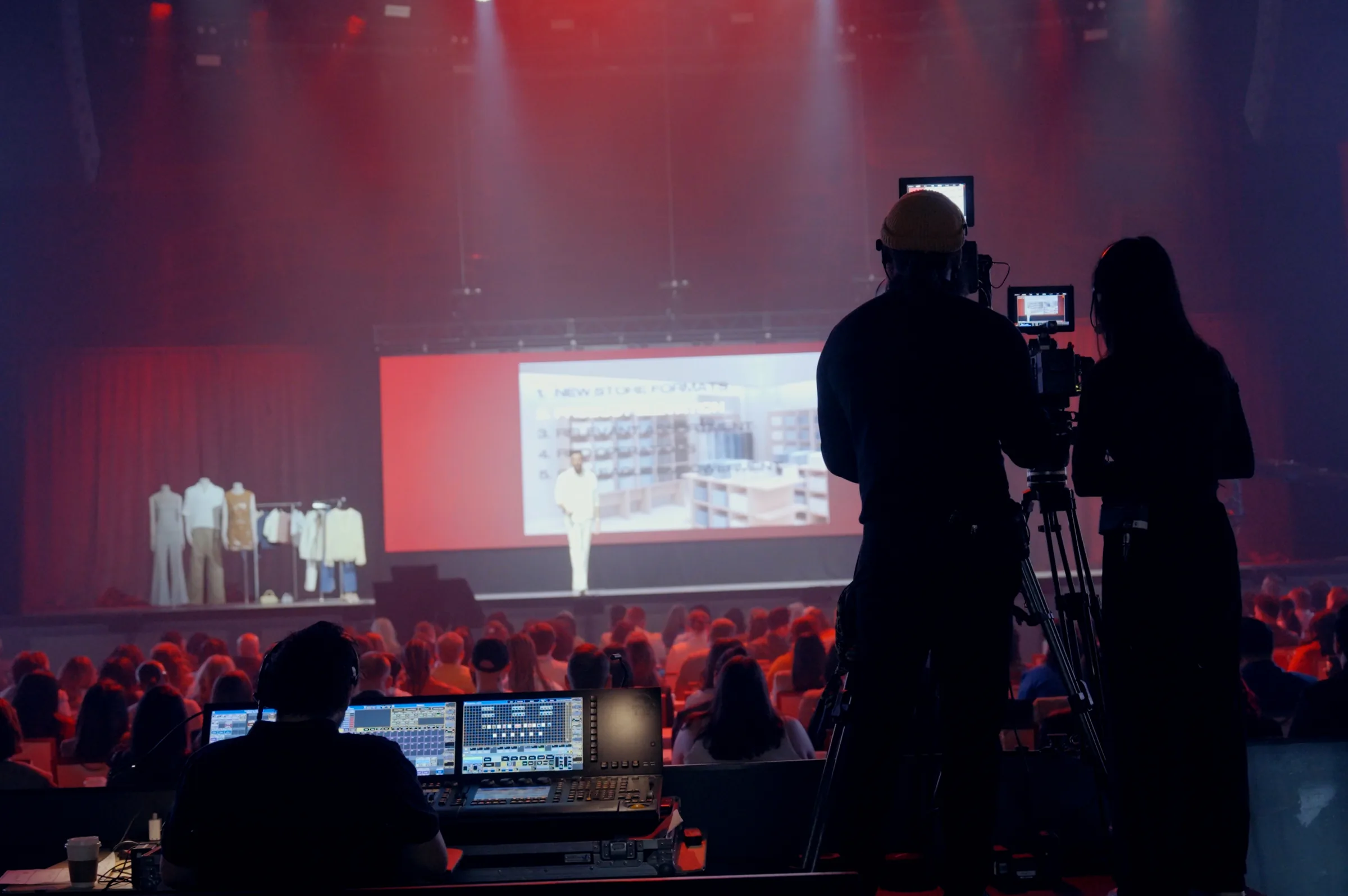
H&M is the other shape this takes. For their Region Americas division we produced two internal town halls in New York City, one in a venue we scouted and one built inside their NYC headquarters, then a multi day summit in the largest theater at the Virgin Hotel in Las Vegas. Both town halls streamed live with real time English, Spanish and Canadian French. For Vegas we moved crew across the country and drove our seven ton grip truck from Los Angeles, then ran an eight camera show over four days of setup, rehearsal and execution. Two cities, two very different formats, one team holding all of it.
What a brand should ask first
How many cities actually earn their slot
More cities is not more impact. Each market has to earn its place with a real reason, a location you cannot fake elsewhere, a regional audience, a facility that only exists there. If a city is on the list because it felt comprehensive, cut it. A tighter plan shot well beats a sprawling one shot thin.
Does the work need motion, stills, or both
Some campaigns are pure film and belong in our film and television workflow. Some are documentary in spirit and run through documentary production. Many brand campaigns want motion, stills, and social cutdowns from the same footage, which is where tight continuity pays off twice. Deciding this before the first shoot day changes how every unit captures.
Who carries the brand system across markets
If the campaign has to match an existing brand look, our branding and content team sets the visual rules the shoot units follow, and when the deliverables include anything interactive we loop in web and tech early so the footage is cut for where it will actually live.
Multi city production questions
How many cities can one video production cover?
There is no fixed limit. The real limit is whether one producer can keep every city on the same plan. Our Celsius commercial covered six cities in 14 days. More cities only make sense when each one earns its place.
Do you fly one crew to every city?
Mostly no. We staff complete local crews in each market and run them to one standard, and a small core team travels when the creative needs the same eyes in every room. On Celsius every city had its own full production team.
How do you keep footage from different cities matching?
One locked creative document, one camera and lens family, a color reference shot at the top of every setup, and one base look in the grade that every city is corrected toward.
Who is the client’s point of contact?
One producer for the whole campaign, across every market. That person holds the creative, the schedule and the status of each city.
Where C&I Studios comes in
We run multi city video production as one campaign with one spine. One creative held firm, local crews run to a single standard, gear and color locked so the footage matches, a schedule built backward from delivery, and one producer who owns all of it. We shoot across roughly seventeen metros and we keep a studio in Los Angeles plus teams in New York and Fort Lauderdale, so a national campaign does not mean handing the work to strangers in each market.
If you have a campaign that needs to land the same way in several cities at once, tell us the markets and the delivery date and we will build the spine around them. Start that conversation on our contact page and we will take it from there.